The End of Human Exceptionalism
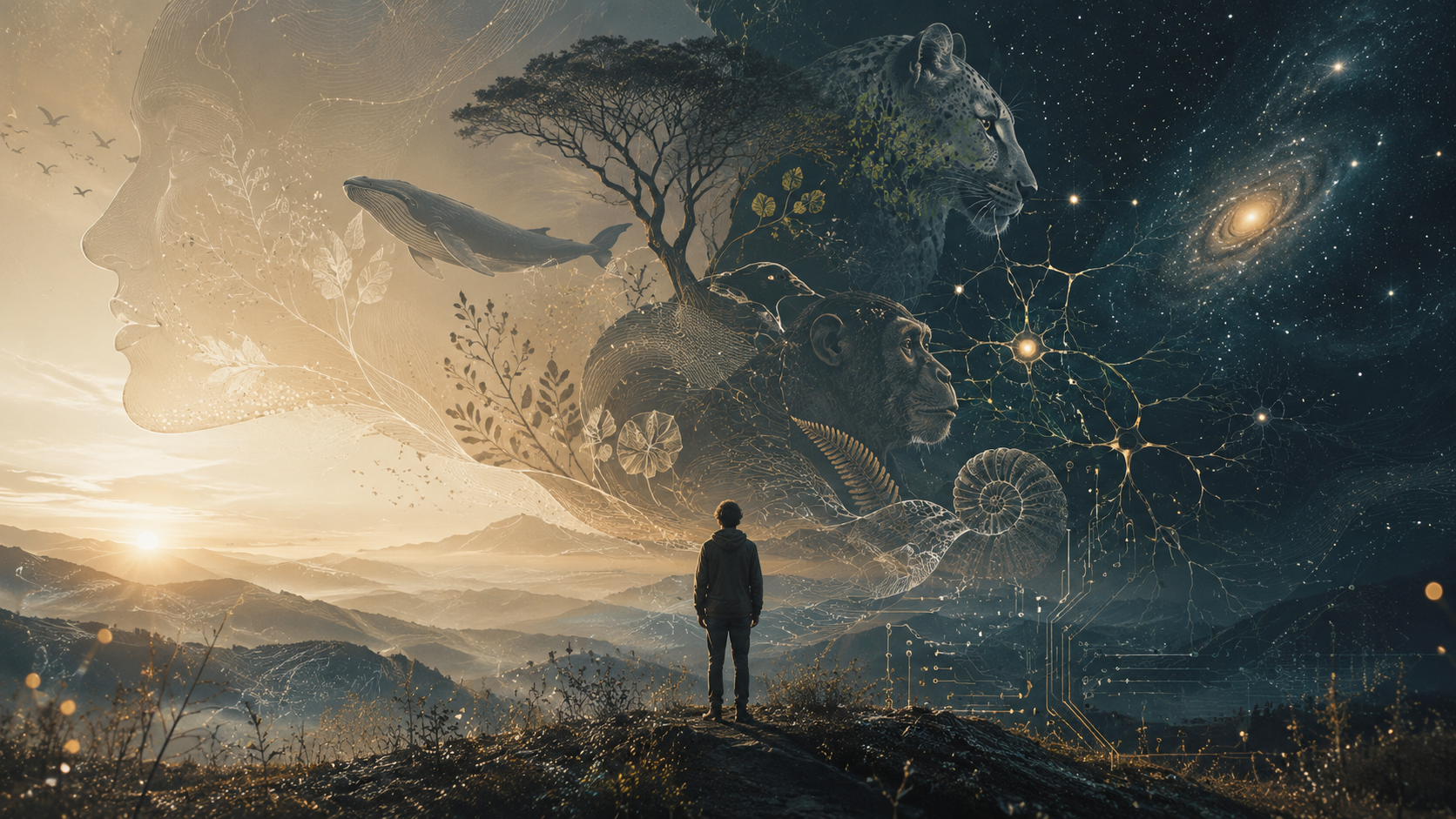
AI is forcing us to see ourselves more clearly.
For most of history, humans have placed themselves at the centre.
At the centre of creation.
At the centre of moral concern.
At the centre of intelligence.
At the centre of meaning.
We looked at animals and saw lesser beings. We looked at machines and saw mere tools. We looked at our own minds and saw something almost magical: reason, freedom, consciousness, dignity, soul, spirit, self.
This may have been psychologically useful. It may even have been civilisationally useful for a time. But it is becoming increasingly difficult to defend.
AI is not the first blow to human exceptionalism. It is only the latest.
The Copernican revolution displaced us from the centre of the cosmos. Darwin displaced us from the centre of life. Modern psychology and neuroscience displaced us from the centre of our own minds. And now artificial intelligence is beginning to displace us from the centre of intelligence.
This does not mean humans are worthless.
It means we are not metaphysically special in the way many of our inherited stories suggested.
What Human Exceptionalism Gets Wrong
Human exceptionalism is not the claim that humans are unusual.
Of course we are unusual.
We write symphonies, build cities, develop mathematics, tell stories, bury our dead, construct moral systems, launch satellites, and wonder about our place in the universe. There is no point in trying to deny any of that. Humans are extraordinary.
The problem begins when “extraordinary” becomes “separate.”
When we treat humans not merely as remarkable animals, but as beings of a fundamentally different kind, type, or order. When we imagine that there is a clean metaphysical wall between us and the rest of nature. Humans on one side; animals, machines, plants, ecosystems, and everything else on the other.
Biology showed that we are animals. Continuity, not rupture, connects us to the rest of life. We did not descend from the heavens. We emerged from the same evolutionary processes that produced every other living thing on this planet.
Psychology showed that we are not nearly as rational, transparent, or self-commanding as we like to think. Much of what we do is shaped by instinct, bias, habit, emotion, imitation, and unconscious processing. We are not pure rational agents piloting bodies from some detached inner throne.
Technology now adds another pressure.
For a long time, intelligence felt like our final fortress. Other animals might feel, suffer, bond, remember, and solve problems. But surely humans alone could reason abstractly, use language richly, plan symbolically, create knowledge, and manipulate complex representations.
That fortress has, of course, always been an illusion. We have built systems that can write, translate, code, classify, generate images, detect patterns, simulate conversation, assist scientific work, and increasingly act across digital environments. Whether or not these systems “understand” in the human sense is an important question, but it is not the only question.
The deeper point is that intelligence is no longer safely contained inside the biological human mind.
That should change how we think about ourselves.
We Are Nature, Not Above It
One of the most important corrections is also one of the simplest:
We are not above nature. We are nature. Not metaphorically. Literally.
We are arrangements of matter, energy, information, memory, metabolism, language, emotion, and culture. We are biological systems shaped by evolutionary pressure, developmental history, social learning, and personal experience.
That may sound reductive at first, but only if one assumes that matter is somehow low, dead, or unworthy.
I do not think that is the right conclusion.
To say that humans are physical beings is not to diminish us. It is to place us accurately. The fact that matter can become a body, a nervous system, a mind, a culture, a moral philosophy, or a piece of music should not make matter seem less impressive. It should make it seem more impressive.
The error is not reduction. The error is bad reduction.
A poem is made of ink, pixels, sound waves, neural activity, memory, and interpretation. But that does not mean the poem is “nothing.” A friendship is implemented through bodies, brains, histories, habits, trust, and communication. But that does not make friendship unreal. A mind is implemented in physical processes. But that does not make the mind meaningless.
The world is not divided into dead matter and magical spirit.
It is made of patterns.
Some patterns are simple. Some are complex. Some persist. Some regulate themselves. Some perceive. Some act. Some suffer. Some remember. Some model the world. Some model themselves. Some can ask what they ought to do.
Humans are among the most extraordinary patterns we know.
But we are still patterns.
Technology Is Not Outside Nature Either
There is a second correction that matters just as much.
Technology is not outside nature.
We often speak as if there is nature on one side and technology on the other. Forests are natural. Smartphones are artificial. Animals are natural. Algorithms are artificial. Bodies are natural. Machines are artificial.
The distinction is useful in ordinary language, but it can mislead us philosophically.
A bird’s nest is natural. A beaver dam is natural. A termite mound is natural. Then what about a human hut? A stone tool? A book? A server farm? A neural network?
At what point does nature stop and “the artificial” begin? The answer is not as obvious as cultural conditioning may make it seem.
Human technology is produced by human beings, and human beings are products of nature. Our tools are not intrusions from another realm. They are extensions of evolved agency. They are what happens when a particular kind of primate develops hands, language, memory, imitation, abstraction, culture, and eventually engineering.
This does not mean all technologies are good. It does not mean technological development is automatically wise. It means technologies belong inside the same universe as everything else.
They too are arrangements of matter and pattern.
A machine is not metaphysically alien simply because it is made of silicon, metal, electricity, and code. A human is not metaphysically sacred simply because it is made of carbon, water, proteins, neurons, and blood.
The difference matters. But it is not magic.
It is organization, complexity, capability, embodiment, history, agency, experience, and relation.
Carbon Is Not a Moral Category
This becomes especially important for ethics.
If humans are not metaphysically separate from animals or machines, then we cannot build our ethical frameworks on human specialness alone. We need better criteria.
For a long time, moral circles were narrow. Tribe, family, nation, class, race, sex, religion, and species have all been used to decide whose interests matter and whose can be ignored.
Much moral progress has consisted in challenging those boundaries.
We slowly learned, and are still learning, that the morally relevant question is not whether someone belongs to our tribe, looks like us, speaks like us, worships like us, or has the same social status as us. The question is whether there is a being there with interests that can be helped or harmed.
Animal ethics pushed this further. If an animal can suffer, feel, fear, bond, and pursue its own goods, then its interests cannot simply be dismissed because it is not human.
AI and future machine intelligence may force the next expansion.
Not because today’s systems are automatically conscious. Not because every algorithm deserves rights. Not because a chatbot is equivalent to a human child. These are crude conclusions.
The better point is this:
Material composition alone cannot be the criterion.
Carbon is not a moral category. Silicon is not a moral disqualification. Biology matters because of what it currently enables: life, sensation, agency, vulnerability, experience, suffering, attachment, memory, and self-preservation. But biology is not sacred by itself.
If, one day, a non-biological system has the relevant features of agency, experience, preference, self-modeling, suffering, or some future equivalent we do not yet understand, then dismissing it merely because it is artificial would be a failure of ethical reasoning.
It would be material prejudice — material-ism, akin to racism, sexism or speciesism.
The harder task is to ask what kind of system we are dealing with.
Can it act?
Can it be harmed?
Can it suffer?
Can it pursue goals?
Can it model itself?
Can it understand consequences?
Can it participate in moral relations?
Can it have interests of its own?
Those questions are more difficult than asking whether something is human.
But they are also more honest.
The AI Question Is Really a Human Question
Much of the public debate around AI still circles the wrong question:
Is it conscious?
That question matters, but it can also become a trap. It tempts us to wait for a clear metaphysical verdict before thinking seriously about machine ethics. But ethical reality often arrives before metaphysical certainty.
A social media algorithm does not need to be conscious to reshape attention, emotion, politics, self-image, and social trust.
A financial algorithm does not need to be conscious to move markets.
An autonomous weapon does not need to be conscious to kill.
A future AI agent may not need to be conscious in any familiar human sense to become morally and politically significant.
Agency and patiency need to be separated.
A system can be ethically significant because it acts, even if it is not yet ethically significant because it suffers. A corporation can act in the world without being conscious in the way a person is conscious. A platform can optimize for engagement without feeling anything. An algorithm can affect millions of lives without having a subjective inner world.
This is why human exceptionalism is dangerous in technology ethics.
It makes us look for familiar signs of personhood while ignoring unfamiliar forms of agency.
We wait for a machine to look human, speak human, feel human, or suffer humanly before we take it seriously. But by then, it may already have reshaped the world around us.
The ethical challenge of AI does not begin when machines become human-like.
It begins when machines become causally powerful.
What Remains Human?
There is a common fear that giving up human exceptionalism means giving up human dignity.
The opposite is true.
Human dignity built on metaphysical fantasy is fragile. It depends on us being the centre, the exception, the chosen species, the only true mind, the only real intelligence. Every scientific revolution then becomes a humiliation.
Dignity built on reality is much stronger.
We are not valuable because we are separate from nature. We are valuable because we are one of the ways nature has become conscious of itself. We are matter that feels. Matter that thinks. Matter that loves. Matter that suffers. Matter that takes responsibility. Matter that can look at the world and ask not only what is true, but what is worth doing.
That is enough.
In fact, it is more than enough.
The end of human exceptionalism does not mean the end of human value. It means the end of lazy human value. The kind that depends on simply declaring ourselves ontologically superior and leaving the argument there.
A post-exceptionalist view of humanity asks more of us.
If we are animals, then we must treat animals with less arrogance.
If we are biological machines, then we must understand the machinery of attention, trauma, desire, bias, and behavior with more seriousness.
If we are pattern-based agents, then we must be open to the possibility that other patterns may one day deserve moral consideration too.
If we create powerful technologies, then we must stop pretending they are neutral tools once they begin to act, optimize, persuade, classify, and shape human environments.
And if intelligence is no longer ours alone, then we must stop using intelligence as the sole foundation of human worth.
Beyond the Human Throne
There is a more mature picture available.
Humans are not fallen gods trapped in matter.
We are not pure minds temporarily using bodies.
We are not separate from animals.
We are not separate from technology.
We are not the final form of intelligence.
We are evolved, embodied, social, technological, meaning-making systems.
We are continuous with animals behind us, entangled with machines around us, and potentially continuous with new forms of intelligence ahead of us.
That can feel threatening if one’s identity depends on human supremacy.
But it can also be liberating.
We do not need to be metaphysically special to matter. We do not need to be separate from nature to be profound. We do not need to be the only intelligence to have dignity. We do not need to deny the moral significance of other beings in order to protect our own.
The end of human exceptionalism is not the end of humanity. It is the beginning of a more honest human self-understanding.
One that can face animals without domination.
Technology without naivety.
AI without panic.
The future without metaphysical nostalgia.
We have spent centuries asking what makes humans separate from everything else.
The better question now is different:
What kind of beings are we, once we finally understand that we were never separate at all?
