Why Our Moral Intuitions Fail in the Age of Complex Technology
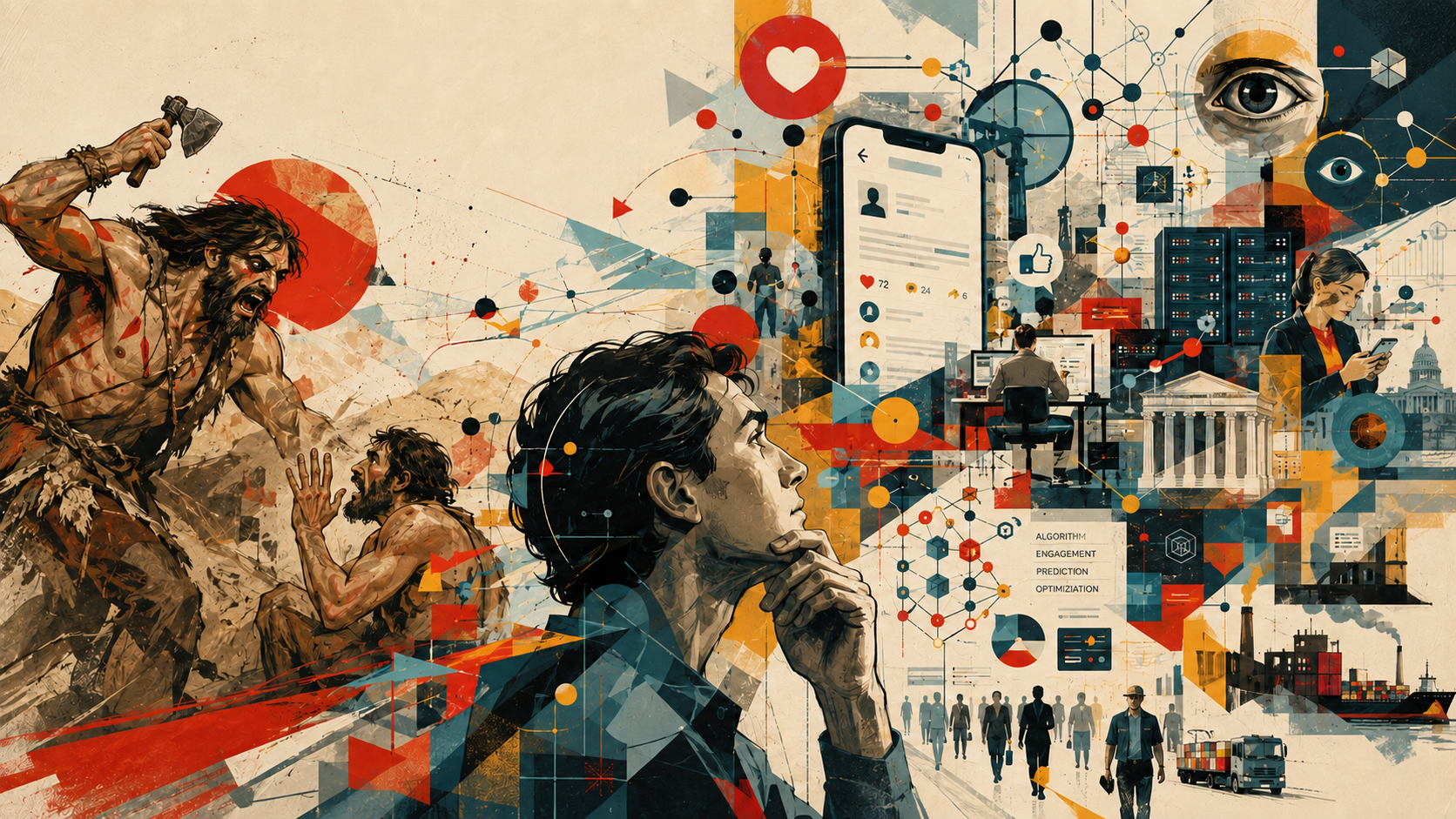
Our moral instincts evolved for faces, bodies, and direct harm. Modern technology hides its moral structure behind interfaces, systems, and scale.
Social networks commodify personal data. Digital rights management software restricts what people can do with things they believe they own. Corporate back doors weaken trust in our devices. Global surveillance systems watch citizens at a scale no previous society could have imagined. E-waste is shipped elsewhere, out of sight. Much of the hardware and infrastructure of our digital lives depends on labour conditions we would rather not see.
These are not obscure moral issues. They define the technological world we live in. Yet many of them remain strangely muted in public moral life. We may be vaguely aware of them. We may even agree, when pressed, that something is wrong. But often they do not grip us in the way more familiar moral violations do. They do not produce the same immediate ethical force as a visible act of violence, betrayal, cruelty, or theft.
Why?
One answer is obvious: many people and institutions profit from the status quo. There are strong incentives to keep certain technological harms hidden, abstract, or normalised.
But there is another reason that interests me here.
We lack well-formed moral intuitions toward complex technology.
This does not mean that we lack moral concern altogether. It means that the fast, intuitive, emotionally charged part of our moral psychology often does not recognise complex technological systems as moral situations in the first place. A punch, a theft, an insult, a crying child, an injured animal, or an angry person holding a weapon immediately appears to us as morally loaded. A data broker, a recommendation algorithm, an opaque interface, a hidden tracking system, or a proprietary AI model often does not.
That is the problem.
Not only that technology has become powerful, but that it has become powerful in ways our moral intuitions do not easily see.
Automatic Morality
For a long time, humans liked to think of themselves as primarily rational beings. We imagined ourselves as observers and deliberators, creatures who first understood the world and then acted upon it through reason. That picture has become increasingly difficult to maintain.
Moral psychology has made this especially clear. Much of human moral judgment is not the result of slow, conscious reasoning. It is fast, intuitive, emotional, and only later rationalised. We usually feel first and explain afterwards.
Joshua Greene compares this to the difference between automatic and manual mode on a camera. Most of the time, we point and shoot. Only in more difficult or unusual situations do we switch to manual mode and adjust things deliberately. Jonathan Haidt uses a different image: the elephant and the rider. The elephant is the powerful intuitive system. The rider is conscious reasoning, sitting on top and often pretending to be in charge.
Both metaphors point to the same basic structure. Much of morality begins beneath deliberate thought. A situation strikes us as wrong, dangerous, unfair, disgusting, cruel, or noble before we can fully explain why.
This is not a defect. It is necessary. We could not reason from first principles about every ordinary social interaction. We need fast moral perception. We need to recognise danger, betrayal, unfairness, dominance, loyalty, care, and harm quickly enough to act.
But the usefulness of moral intuition depends on the environment.
Our moral intuitions evolved and developed in a world of bodies, faces, gestures, voices, direct action, immediate consequences, and small-group social life. The question is what happens when the moral world no longer looks like that.
The Lever and the Body
The trolley problem is useful here, not because it tells us what the correct moral answer is, but because it reveals something about how our moral mind works.
In the classic version, a runaway trolley is heading toward five people. A bystander can pull a lever and divert the trolley onto another track where one person will die. Many people judge that pulling the lever is morally permissible. One dies, five are saved.
In another version, the bystander stands on a footbridge next to a large person. The only way to stop the trolley is to push that person off the bridge, killing him but saving the five. Here many people judge the action impermissible, even though the arithmetic is similar.
The difference is not merely logical. It is psychological. Pulling a lever is mediated, mechanical, and impersonal. Pushing a body is direct, physical, and emotionally charged. The overpass case activates a much stronger moral intuition against personal violence.
This matters for technology because the lever is already a technology. A simple one, but still a mediating device. It stands between the person and the harm. The causal chain is still easy enough to grasp: pull lever, change tracks, trolley moves, one dies instead of five. But even this simple mediation changes the moral feeling.
Now extend the causal chain.
Replace the lever with software. Replace the visible trolley with statistical outcomes. Replace the five workers with a population segment. Replace the single track with a model update, a ranking function, a data-sharing agreement, a product metric, a recommendation system, or a default setting buried inside a platform.
At some point, the moral intuition fades.
Not because nothing morally relevant is happening, but because the situation no longer resembles the kinds of moral scenes our intuitions were built to recognise.
Modern technological harm often looks less like pushing someone off a bridge and more like adjusting a hidden lever in a system whose consequences are delayed, distributed, probabilistic, and hard to see.
The harm may be real.
But the elephant does not move.
From Spears to Platforms
Consider an angry person holding a spear.
Almost immediately, we understand the situation. The angry face, the weapon, the posture, the direction of movement, the vulnerability of bodies — all of it is legible. We do not need an ethics seminar to recognise danger. The moral and practical significance appears at once.
Now consider the landing page of a social network.
A clean interface. Familiar colours. Friendly icons. A login button. Maybe a smiling photo. Nothing about it feels like danger in the same way. There is no aggressive body. No weapon. No blood. No scream. No obvious victim. No immediate violation.
And yet behind that smooth surface may sit extensive behavioural tracking, psychological profiling, emotional experimentation, advertising auctions, political targeting, social comparison loops, persuasive interface design, and incentives to increase engagement even when engagement makes people anxious, angry, dependent, or misinformed.
The spear announces itself.
The platform does not.
That is the moral asymmetry.
The technology with the most obvious moral feel may not be the technology with the greatest moral significance. Our intuitions are loud when the danger is ancient. They are often quiet when the danger is systemic, abstract, profitable, and hidden behind convenience.
This creates a very specific problem. If a moral intuition is triggered, conscious reasoning has something to work with. The rider can try to guide the elephant. Manual mode can be activated. But if no moral intuition arises at all, we may never even realise that deliberate ethical reflection is needed.
Where there is no elephant, there is no rider.
Where there is no moral camera, there is no manual mode to switch into.
Black Boxes and Moral Invisibility
Modern technology does not only hide its mechanisms from ordinary users. It often hides the moral situation itself.
A child can learn to use a smartphone before understanding what reading is. A teenager can move fluently through platforms, messages, videos, payments, filters, games, and feeds. Adults often call this technological literacy. But it is usually surface literacy. The user knows what to tap. They do not necessarily know what the system is doing.
They do not know what is being tracked. They do not know what is being inferred. They do not know which ranking systems determine what appears. They do not know what is stored, combined, sold, tested, or optimised. They do not know where their own desire ends and the system’s shaping of that desire begins.
This is not just a technical issue. It is a moral-perceptual issue.
The user sees convenience. The system sees behavioural data.
The user sees a feed. The system sees engagement.
The user sees a recommendation. The system sees prediction.
The user sees personalization. The system sees influence.
The user sees a button. The system sees an experiment.
A black box is not only a system we do not understand. It is a system whose moral dimensions do not naturally appear to us. The surface may be friendly, smooth, playful, useful, or beautiful. The moral structure sits beneath.
This is why many technological harms become normalised. They do not feel like harms. They feel like use.
The Wrong Objects of Outrage
Because our intuitions are poorly calibrated for complex technology, we often become outraged at the wrong level.
We blame the user rather than the interface. We blame the post rather than the recommendation architecture. We blame the worker rather than the incentive system. We blame the algorithm as if it were a person, or we blame one visible person while ignoring the institution that shaped the algorithm. We worry about whether a machine feels, while ignoring what the machine does.
Complex technologies are rarely morally simple. They are not demons. They are not neutral objects. They are systems built from human intentions, institutional incentives, technical constraints, economic pressures, cultural assumptions, and feedback loops.
Our intuitions prefer faces. Complex technology often has no face.
This is why physical robots attract disproportionate attention. A robot that looks at us, moves near us, or physically harms someone immediately enters our familiar moral space. An autonomous car killing a pedestrian is a visible ethical event. A drone strike, a factory accident, or a surgical robot failure activates strong intuitions because there is bodily harm and a clearer causal story.
We should take such cases seriously.
But they are only one part of technology ethics.
A system can harm without touching. It can erode privacy, manipulate attention, create dependency, silently discriminate, alter incentives, distort public discourse, make some people more visible and others less visible, and shift institutional responsibility into technical opacity.
These harms are not less real because they are less visceral.
They are simply less intuitive.
The Human Test
If our moral intuitions fail to respond to complex technology, one useful strategy is to create deliberate cultural substitutes. We can intentionally translate technological behaviour into forms our moral psychology understands better.
One technique I have used before is simple:
Ask what the technology would look like if it were a person.
Take a social network. Instead of thinking of it as software, imagine a person following your friend everywhere. This person carries a camera, a microphone, a notebook, and a set of psychological tests. He records where your friend goes, what she says, who she talks to, what she reads, what she likes, how long she looks, when she is lonely, when she is angry, when she is persuadable.
He sends some information to powerful institutions. He auctions other information to advertisers. He runs experiments to see which emotional states make your friend more engaged. He selectively shows and hides information to influence behaviour. He presents himself as helpful, social, and indispensable, but his real loyalty is to profit and control.
If such a person existed, we would not call the relationship neutral. We would call it manipulative, exploitative, perhaps abusive.
The point of this thought experiment is not to say that the technology literally is a person. It is not. The point is to make a hidden moral structure visible by pulling it into the range of human moral intuition.
This is an artificial intuition pump.
And we need more of them.
Because many modern technologies will not trigger moral concern on their own. They must be translated into moral language, moral images, and moral metaphors that allow us to feel what is otherwise too abstract to notice.
AI Intensifies the Old Problem
AI does not create this problem from scratch. It intensifies it.
The moral invisibility of technology was already present in social networks, DRM systems, surveillance infrastructures, opaque supply chains, recommender systems, digital advertising, and proprietary software. AI adds new layers of abstraction, speed, adaptability, and apparent agency.
Machine-learning systems can be black boxes in a deeper sense than many earlier technologies. Traditional software, at least in principle, follows instructions written by humans. It may be complex, but its logic can often be traced. Machine-learning systems are trained on data and develop internal structures that may not be easily understood even by their creators.
This creates several problems at once. The system may be opaque. It may produce outputs for reasons we cannot easily explain. It may behave differently in different contexts. It may reproduce patterns no one explicitly intended. It may generate plausible but false information. It may classify, rank, recommend, persuade, infer, or act inside institutions whose incentives are already morally compromised.
And again, the harm may not look like harm.
An AI system that changes who receives credit, employment, education, visibility, attention, care, or suspicion may not trigger the same emotional response as direct discrimination by a person. A system that generates addictive personalization may not feel like coercion. A system that automates judgment may appear objective precisely because its moral structure has been hidden behind technical language.
This is why AI ethics cannot be limited to spectacular cases of rogue machines or human-like robots. The more ordinary danger is quieter: AI inserted into existing systems, amplifying incentives we have not examined, producing consequences we cannot easily see, and operating at scales our intuitions were never built to track.
AI is complex technology becoming more adaptive, more persuasive, more opaque, and more deeply integrated into human life.
That is why the old moral-intuition problem matters more now.
Adaptation Is Not Understanding
There is a comforting belief that humans will adapt to new technology.
In one sense, we will. Humans are extraordinarily adaptive. Children learn interfaces quickly. Workplaces absorb new tools. Societies reorganise around new infrastructures. What once seemed strange becomes ordinary.
But adaptation is not understanding.
And adaptation is not ethical success.
People can adapt to surveillance. They can adapt to constant interruption. They can adapt to social comparison. They can adapt to opaque ranking systems that shape their opportunities. They can adapt to being treated as data sources, prediction targets, or attention units.
The fact that a technology becomes normal tells us very little about whether it is good.
In fact, normalisation may be part of the problem. Once a technology becomes embedded deeply enough, it disappears into the background. It becomes the environment. We stop asking whether it should be there because we no longer experience it as an object of choice.
Our intuitions adjust to the surface.
The system continues underneath.
Intuitions Are Not Enough, But They Still Matter
None of this means moral intuitions should be discarded. That would be impossible and undesirable. Moral intuitions are part of how we notice that something matters. They are alarms, social sensors, and pattern recognisers. They help us respond to cruelty, unfairness, betrayal, coercion, humiliation, and danger.
The problem is not that we have intuitions.
The problem is that we mistake them for final judgment.
In a complex technological world, moral intuition should be treated as an initial signal, not a complete ethical framework. Sometimes the signal is accurate. Sometimes it is miscalibrated. Sometimes it is too loud. Sometimes it is too quiet. Sometimes it is aimed at the wrong object.
The task is not to suppress intuition, but to educate it.
We need to learn where it fails. We need cultural tools that make invisible harms visible. We need metaphors, examples, design principles, institutions, audits, and public language that allow us to recognise the moral structure of systems we cannot directly perceive.
This is where ethics becomes practical. It is not enough to write principles. We need to design moral visibility into technological life.
Designing for Moral Visibility
If complex technology hides moral consequences, then one task of ethics is to make those consequences visible again.
This is not only a philosophical task. It is also a design task, a governance task, a leadership task, and a cultural task.
Interfaces should not only be easy to use. They should make important consequences understandable. AI systems should not only be accurate. They should be auditable, contestable, and accountable. Platforms should not only optimise engagement. They should expose the trade-offs between attention, wellbeing, truth, and profit. Institutions should not be allowed to hide behind technical systems they choose to deploy.
Users should not be expected to carry all responsibility for systems deliberately designed to exploit their limitations. Regulators should not wait until harm becomes visible in the old bodily sense before acting. Designers should not assume that because a feature increases usage, it is therefore good. Leaders should not confuse technical capability with ethical legitimacy.
The moral challenge is to build systems whose ethical structure can be seen.
Not perfectly. That is impossible.
But enough.
Enough for users to understand what is being done to them. Enough for auditors to inspect what is happening. Enough for institutions to be held accountable. Enough for society to decide which technologies serve human flourishing and which merely train us to accept new forms of extraction.
Better Questions for Complex Technology
The old ethical question was often:
Did someone intend harm?
That still matters. But in complex technology, it is not enough.
Better questions begin elsewhere. What does the system make more likely? Whose interests does it serve? Whose interests does it override? What does it hide? What does it optimise? What does it reward? What does it make easy? What does it make difficult? Who benefits from the opacity? Who bears the risk? What happens when this scales?
These questions are less intuitive than asking who did what to whom. But they are better suited to the world we have built.
Complex technology does not fit neatly into our inherited moral categories. It is not merely object, not quite agent, not usually patient, not neutral, not alive, not dead in the ordinary sense, not good, not evil, not external to us, and not simply us either.
It is part of the causal architecture of modern life.
And ethical thinking must learn to see architecture.
Manual Mode
Our moral intuitions were shaped by a world of visible bodies, direct force, social closeness, and local consequences. That world has not disappeared, but it is no longer enough.
We now live among systems that act at distance, at scale, and through hidden mechanisms. Systems that shape attention, opportunity, desire, knowledge, trust, and behaviour. Systems that can harm without striking, manipulate without threatening, discriminate without hating, and transform society without ever appearing as moral agents in the familiar sense.
This is why our moral intuitions fail in the age of complex technology.
Not always. But often enough that we should stop trusting them blindly.
The answer is not to become cold or purely technocratic. It is to become more reflective, more system-aware, and more willing to move from automatic moral reaction to deliberate ethical analysis. More capable of seeing harms that do not arrive with blood, screams, villains, or visible violence.
Technology has outgrown the moral world our intuitions were built for.
So ethics must grow larger too.
The question is not whether we can still feel when something is wrong.
We can.
The question is whether we can learn to see what our feelings miss.
